

Creating power in the work place not only improves the conditions for the workers who have organized, but it creates a path for all workers.
Not to be hyperbolic, but this is a Q&A I’ve longed to publish. Beyond my own long relationship with Starbucks, I have an even greater respect and appreciation for the strikers. They are redefining labor actions.
Their requests are reasonable, their tenacity is impressive, and their methods are making inroads. I hope each of you has stopped purchasing anything from Starbucks. Not in a store, not in the aisle of grocery store, not gear for Pride. That’s the ask of us – delete the app, give up your stars, and show up. There is no lack of locally owned coffee houses you can support.
If you think “wait they aren’t unionized either?” read on because they address it.
When I take the time to think about why I liked Starbucks so much, I’m not going to be coy and say “the people” in the sense that I had ongoing casual contact with specific baristas. Of course, I liked and valued them in that general Democrat left of center, mildly progressive sort of way. They worked for a place I valued.
I was wrong.
They are the reason I derive so much value from Starbucks. The baristas, all of the unknown workers behind the scenes, the folx whose labor is literally poured into my cup are fundamentally tied to the servers at nearby restaurants, clerks at the mall, the Uber driver, the receptionist at my dentist, tattoo artists, the tie that binds them is what actually makes America great. The forces of capitalism that hold them down is what is dragging us backwards.
I don’t know why this Q&A connected those dots. It isn’t an especially original idea, but I do see how radical workplace liberation is within local moderate to progressive circles. That’s a blog post for another day; this is about k and their experience as a worker in our society.
Shame on you if you still patronize Starbucks. It isn’t a hard line to draw in your life, nor is it rationalized by the many other capitulations we make in a capitalist society. Some trade-offs are unavoidable due to lack of resources and information. Not going to Starbucks isn’t a heavy lift for the majority of us.
The holds even more true if you are LGBTQ+ – this strike is redefining the role of our community in the workplace and their unique needs. Show up for them.
I deleted the app. I haven’t been to Starbucks since the union asked for that support. I still get random email messages, most recently informing me of some secret perk if I just use my stars before they expire in June. I don’t think I have any stars so that feels like a bait and switch – shocking!
The secret menu insight into Starbucks operating as a bank was a mind blowing realization.
If one workplace is organized and gains material benefits, other workers will not only feel empowered and inspired to organize their own workplace, but their employers will need to follow suit in order to “keep up with competition” per se.
name: k
pronouns: they/them
role union/strike: worker leader/organizer, bargaining delegate, strike captain
How do you describe your identity? dyke!
What was your first impression of Pittsburgh? silly city comprised of pockets of neighborhoods- a friendly place
How did you begin working for Starbucks? What positions have you held? I needed a part time gig while attending college- l have been a barista and now a shift supervisor
What’s the best kept secret most people don’t know about Starbucks beyond the secret menus?Something else.
starbucks is the biggest bank in the world- all thanks to the mobile app! when you load money onto their app that is free money they get to play with even if you haven’t spent it in their stores yet 
Starbucks workers have unionized store by store across Pittsburgh and beyond. Please tell us how that effort got started and the current status? our organizing efforts began in Buffalo, NY in 2021 and have now expanded nationwide to include nearly 700 stores
How many stores are in this region? How many are striking? 21 are unionized in pittsburgh and about 11 stores ended up going on our longest strike in our unions history.
Our struggle and our work towards getting a contract is a way to protect our communities at high risk.
There’s a perception that Starbucks union members are generally younger and more representative of the community than trade unions. Is this accurate? How does that impact organizing? I would say the makeup of our union is definitely on the younger side & many are members of the LGBTQ community. I think this presents both challenges and positive elements to our organzing. On one hand, there’s a lot of learning through first time experiences with younger individuals, but there are also lots of creative ways of thinking in terms of our organizing strategies, social media focuses & outreach, etc. It feels as though there is a resurgence of labor organizing nationally and I think it’s important that young people are also feeling like they can be involved in that.
Pittsburgh is a labor town. How does the Starbucks Workers National fit into that legacy? We have been warmly welcomed into the already existing union culture and history of Pittsburgh. Pittsburgh’s solidarity runs deep and some of the most unifying moments were on our very own picket line with other local union members.
What are your demands?
Right now we are trying to finish our contract. We ask that the company meet these current demands:
- 3 workers on the floor—always
- $17/hr starting wages for lowest-paid baristas
- 4% annual raises for economic security
- Available hours go to current baristas
- A fair dress code
- Non-discrimination & just cause protections
- Health & safety protections
- No more union busting
How has the company responded? The company, while back at the bargaining table with us, has tried to reopen already agreed upon articles within the contract we have both agreed upon. This is setting our barging backwards rather than moving forwards but we will continue to fight until we get what we deserve.
Before the strike, I’ve walked into stores that are wall to wall customers with only two employees doing everything. What is a typical shift like under current conditions? Currently, these conditions still exist, and quite frequently at that. Stores are consistently understaffed while partners are scrambling to get enough hours to make ends meet, with many being scheduled under the required hours to qualify for benefits. A 30+ minute wait time on food and beverage is not uncommon, creating a tense work environment for customers and partners alike.
Your union tactics have been outside the box thinking – the one day/one store strikes, the ‘Red Cup Rebellion’ and Camp Contract. What feedback has the union received? Having a wide range of actions allows for our union to be active while having range in participation. I think it’s important to allow newer members to grow their confidence with organizing actions by getting involved through actions that allow them to take ownership of their union while learning the ropes of it all.
The union has also been actively using social media in a way that feels fresh and engaging? To me, you are creating content not simply uploading videos and photos. Can you speak aboutt the role of social media? With the makeup of our union being on the younger side, social media has been a pivotal tool in our fight. Not only does this form of outreach resonate with the members of our union, but it also strikes a chord with our community members and allies who interact with us. Hearing our stories through a tik tok algorithm or an instagram feed helps us to spread our message and gain traction both in stores and in our communities.
To be clear, you are asking customers to not purchase any Starbucks product from anywhere – no stores, no kiosks in box retailers, no packaged items in grocery stores. Is that accurate?
Yes. Until there is a fair contract we still ask that people refrain from giving Starbucks their business.
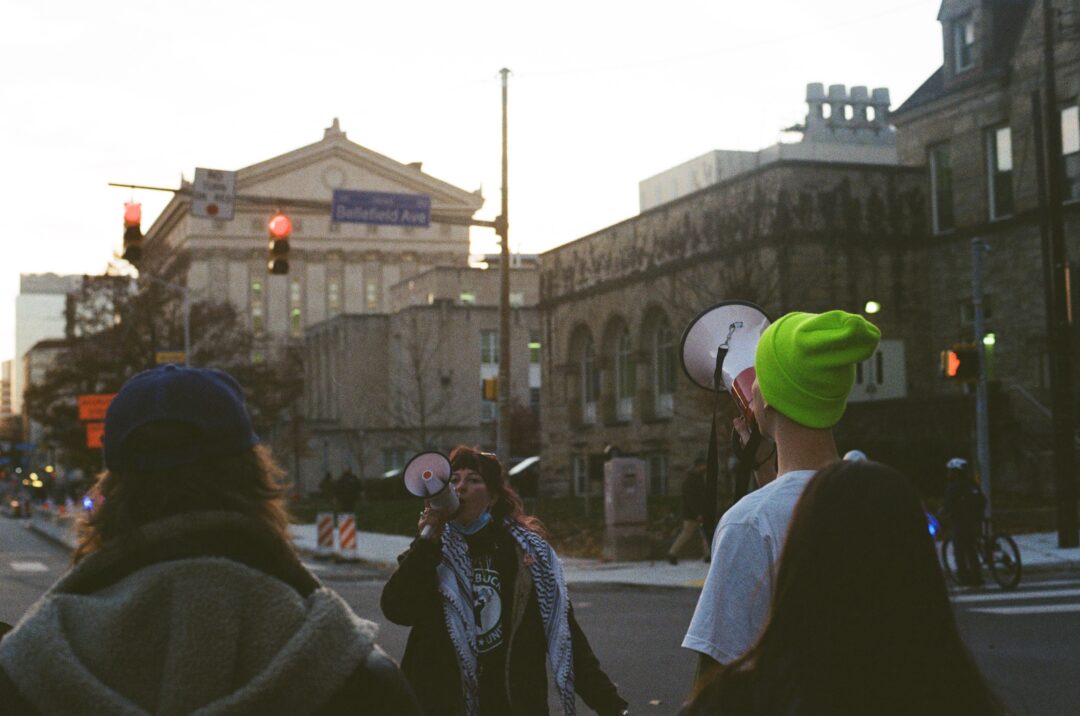
What does your typical day on strike look like? How has the strike impacted your day to day life? A day on strike looks like waking up early, heading to a picket line, picketing in a circle with signs and chants for a few hours. It’s meeting our community allies in the streets and letting customers know why we’re striking and how they can help. It was one of the most unifying acts where the care and love we have for one another was palpable. It felt good to get out there and make our demands known- to the company and to the public.
Labor organizing has included Pittsburgh’s libraries, museums, mental health agencies, fast food restaurants, grad students and other workers who don’t fit a mold, perhaps because we don’t value their work or see it as actual labor compared with the trades.
Retail and food service jobs are still considered a rite of passage for high school and college students, a crappy job experience we all need to endure on our way up the workforce ladder. How does labor organizing a workforce transcend the various type of work and focuses on the workers?
Organizing your workplace is about liberation for all, as the working class is unified by all identities. Retail and service work is not work done only by teenagers and those who have yet to build a network or a resume- it’s the work that is deemed essential, even during international tragedies (our stores were kept open during covid lockdown) but is paid the lowest. Creating power in the work place not only improves the conditions for the workers who have organized, but it creates a path for all workers. A win for one is a win for all. If one workplace is organized and gains material benefits, other workers will not only feel empowered and inspired to organize their own workplace, but their employers will need to follow suit in order to “keep up with competition” per se.
I asked earlier about the role of age and diversity in the Starbucks workforce. Is the expansion of organizing and the resistance tied to the fact that the workforce has fundamentally changed in ways that threaten capitalism and white privilege?
I think people are beginning to realize that the current system is not working. And the current system is built upon the backs of the working class, of people of color. That our power and our strength comes from standing up together and demanding what we deserve. Our labor is exploited for the rich to get richer while the poor get poorer. When we organize, we are taking the power of our labor back and we are demanding our what we deserve and what has been stolen from us.
Are there themes that intertwine your strike with the authoritarian government, the targeted kidnapping of our BIPOC neigihbors, the threats to abortion care and healthcare for trans youth?
Everything is interconnected. Our union has made demands to the company to not comply with or allow ICE into our stores. We are fighting for trans healthcare for our partners. Our struggle and our work towards getting a contract is a way to protect our communities at high risk.
Beyond honoring the picket line, how else can the community support you?
Get in touch with local organized baristas and attend their events! Organize your own workplace! Have conversations with others about the importance of honoring boycotts and workers demands. Most importantly- get to know your neighbors and build your own community.
Please share the socials and links for Pittsburgh and National accounts
@sbworkersunited (national)
@sbucksworkersunited (pgh)
To be clear, you are asking customers to not purchase any Starbucks product from anywhere – no stores, no kiosks in box retailers, no packaged items in grocery stores. Is that accurate?
Yes. Until there is a fair contract we still ask that people refrain from giving Starbucks their business.
Thank you, k.
Discover more from Pittsburgh Lesbian Correspondents
Subscribe to get the latest posts sent to your email.






You must be logged in to post a comment.