
Kelly-Strayhorn Theater is producing an interesting show this weekend as part of their Freshworks creative residency.
A mother creates an AI chatbot of the daughter she’s lost to help her mourn. But her child is very much alive, and he goes by Dustin. Now spending more time talking to a version of her child who never transitioned, the mother’s memory of the past fractures the present, leaving Dustin trying to hold the pieces together.
I am very much much hoping to get to see this show on Saturday. It is a fascinating concept. I had a chance to interview the playwright for this series. Now I’m even more fascinated.
They even worked in some great Gene Kelly context.
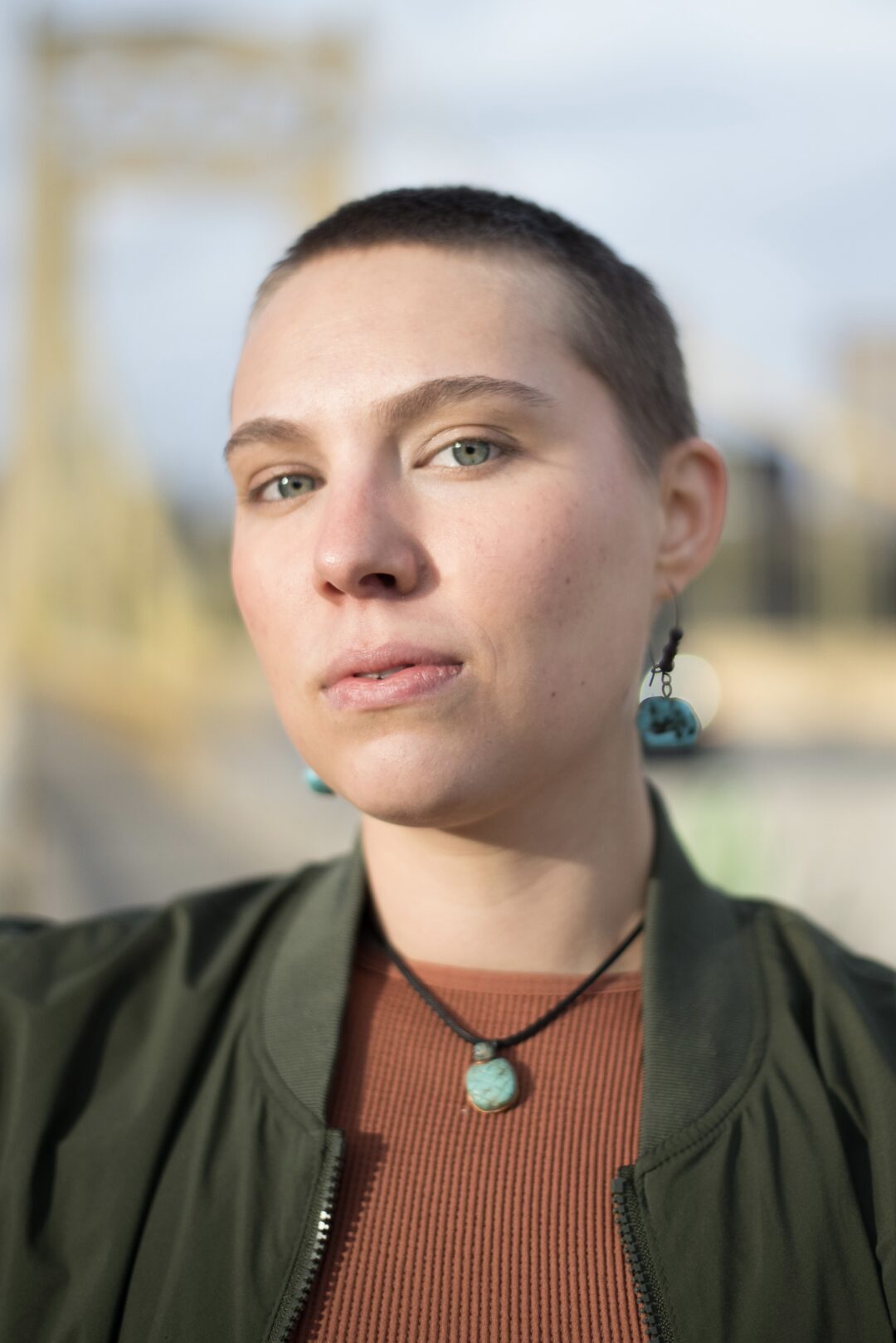
Name: Mal MacKenzie
Pronouns: they/ them
Your Affiliation with the Arts: Actor/ Playwright
How do you describe your identity? Queer every which way you look at me.
Usually, I choose to express my identity in three abstract images a day. And I encourage others to try the exercise as well.
Today, I am: the smell of campfire smoke lingering in a sweatshirt; a hummingbird’s heart (beating 21 times per second); and a stunning, bright green graffiti tag on a train from very far away.
Tell us about your connection to Pittsburgh.
I was born and raised in Pittsburgh. I went to school here, all the way up through high school at CAPA (Marissa Lily, who is in the cast of AURA, was one of my elemetary school classmates actually.). This is where my family is and it’s a city I have come to love very deeply since returning to it after several years away.
There are real barriers to the arts – time, money, etc. But there’s also the matter of perception, that one must dress a certain way, know the culture of their local arts community or be knowledgeable about the medium . How does the creative community collectively lower these barriers so people actually learn if you like opera, ballet, plays, or symphonic music as a few examples?
I think the first thing we have to reconcile is that in the United States artistic mediums like opera, ballet, and theatre have been gatekept for the last 200 years. Access has been denied based on class, race, language, gender presentation and a whole host of other qualifications. If you don’t get the chance to experience the work, if you’re constantly told you won’t “get” it or that it’s not for you, of course you’ll internalize that.Speaking directly on theatre (which I think is such broad category of art that it should be considered seperatly from the others listed in this regard) the root of the artform exists in every single human being and theatrical expression can be found in every single culture on earth. The best thing we can do to welcome more folks into the creative community is to recognize this inherent diversity in storytelling, and lift that up whenever possible.Additionally, these are forms are not singular.
Theatre isn’t just Shakespeare (which was actually enjoyed cross-class in Elizabethan England) and Opera is not only 200 year old works with subtitles over the stage, it’s contemporary compositions like The Parable of the Sower. (
So when someone tells me they don’t like theatre because they don’t like Tenassee Williams or RENT, I say great, you should come see my play, cause I’m doing something really different over here.
Maybe you’ll like it, maybe you won’t, but it will definitly show you something new.
Now I don’t think those real barriers are insignificant. Who is going to take a risk on something they might hate if it costs them $45 bucks for a seat? In this economy?
So that’s why we need structures like rush tickets or first time discounts. I always try to comp people I know when they’re on the fence, that might be the difference between never attendinging and a new regular.
Tell us about an under-appreciated or underutilized cultural resource in this region.
Okay I have to say two. The first is obviously going to be the Kelly Strayhorn. This organization is genuinley lifting up local artists and the community in such a unique way here in Pittsburgh. Where else can you find an artistic residency like FRESHWORKS? Where the artist can get buy in for something as simple as a few pages of a first draft? KST tickets always operate on an elective sliding scale no questions asked and most imporatantly, this team understands the vital role of the artistic space as a physical community space. The Strayhorn hosts seminars on affordability, political engagement, budgeting for retirement, and the door is held open for anyone to attend, not just artists.
So hit up the Kelly Strayhorn and not just for my show, but for all of their programing.
The second cultural resource I want to call out is your friends! Your friends are huge! Nobody needs an institution to give them permission to make art. Gather folks in your home, at the library, at a park and read a play out loud together (or ask me about Play Reading Club). Host a poetry reading night or a crafternoon or a jam sesh. Culture is created and you get to make it wherever and whenever and however you want.
With whom in the Pittsburgh region would you like to collaborate and why?
This is such a tricky question because Pittsburgh is big, but the theatre community is really so small, and a lot of us are multi-hyphanate artists.
I’m quite lucky to be at a place in my career where I’m looking forward to collaborating with some folks next year who I’ve been admiring for a long time.Many folks I’ve already worked with in some capacity are people I’d love to work with again in different capacities. Thinking about TJ Young, who was the dramturg for 69/70 which I was an actor in this past May. Before that production, I saw a develppment showing of one of his own plays last year and thought “damn, I want perform this text”.Someone new? I really love anything that comes out of Theo Allyn’s corner. I’ve seen them perform and I think they’re incredible, I’ve seen some of their writing staged and I nearly peed my pants laughing. So definitley a dream to cross professional paths with them!
Your upcoming production ‘AURA’ at the Kelly-Strayhorn explores the use of an AI chatbox to replicate the child she ‘loses’ due to their gender transition, a child who is now a presumably thriving adult. Is this AI dynamic a path to healing or a path to further denial?
For Shannon, she believes the griefbot is the healthiest way for her to confront these feelings, without putting them onto her child. Of course as we’ve seen with the increasing cases of catastrophic ‘AI Psychosis’ around the world, when a tool confirms all of your internal beliefs and enables extreme conflict avoidance, it doesn’t usually end well.
There’s a lot of conversation about the impact of AI on our community health, especially the environment. Are we having enough conversation about the impact on community mental health?
I would lable AI as a wicked problem, a term used in public policy to describe an issue which has several moving parts and is tangled up in a web of other problems. The enviromental and economic impacts of AI are a part of the community mental health impacts. Those are often driven by the same sorts of forces as social media’s public health impacts, which are themselves exasterbated by economic forces. There are lots of people having the conversation about public health and AI, however I worry those conversations are happening in one isolated corner, while the other conversations are happening elsewhere. And all these conversations are happening within these huge fences of identity and ideology which prevents us from seeing the full scope of AI’s impact.
Is there a queerness to AI that might not be immediately visible, especially to cishet folx?
Okay, I go back and forth on this but today I’m going to say, yes?In the sense that I believe there is are several possible queer readings of machine learning which may be quite obvious to people who have spent time questioning and reflecting on their own gender but perhaps not to cishet folx who have never deeply considered it.I suspect this is a 40 page essay I’ll have to write at some point. Maybe it’s a multi hour long conversation better had over beers or a long walk in the woods. If anyone wants to have that conversation I welcome them to contact me.
Here’s the +1 question
Your profile says you have a background in stage combat and “can’t stay away from shows with lots of blood.” How does stage combat contribute to a robust theater experience? Would you include ‘dance fights’ by one of the theater’s namesakes, Gene Kelly, part of that legacy?
Well without stage combat acting would be a far more dangerous profession. Everyone would be begging to play Horatio and not Hamlet. Beyond the obvious staging of violence, folks with an expertise in stage combat and choreography are often acutely skilled in physical storytelling and creative problem solving. This offers all sorts of techniques for utalizing space, illusion, and bajillion other things in the staging of a show. Neutral Chaos, a choreography group, call practitioners Violent Dance Magicians and that feels pretty accurate.
So, I would absolutley include Gene Kelly in that legacy. Those “dance fights” were super creative illusions using the physical vocabulary of the world he was choreographing in.
socials: Insta @mal.m.mackenzie
Thank you, Mal.
Friday & Saturday, October 2 – 3, 2026
7:30pm – 9:00pm (including post-show discussion)
KST’s Alloy Studios | 5530 Penn Ave.
Pay What Moves You: $15 – $30
Seven with Sue (+1) is one of our favorite Q&A series – a quick dive into the local arts world. (+1) is a nod to my need for a companion when I attend a performance and an acknowledgment of the need for universal accessibility to the arts. If you’d like me to craft a Q&A for your production, email pghlesbianblog@gmail.com. We love talking with actors, directors, stage crew, poets, artisans, and definitely front of house staff.
Previous Q&A’s in this series
Michelle Tibble wants you to escape reality with a room full of strangers: A Seven (+1) With Sue Q&A
Jeremy Mikush wants artists to lead in the revitalization of the city: A Seven (+1) With Sue Q&A
Actor, Director, and Playwright Elizabeth Huffman Changes the Narrative: a Seven With Sue (+1) Q&A
Cartoonist Joe Wos Celebrates the Amazing Friends We Meet Along the Way: a Seven With Sue (+1) Q&A
Actor Phoebe Lloyd Talks About Queering Chekhov in a new local production: a Seven (+1) With Sue Q&A
My ‘Burgh Vivant Q&A with Jill Sobule #7WithSue
My new Q&A column at @BurghVivant with Nicole Gallagher, creator of ‘Mija: one bitch’s tale’
Discover more from Pittsburgh Lesbian Correspondents
Subscribe to get the latest posts sent to your email.