
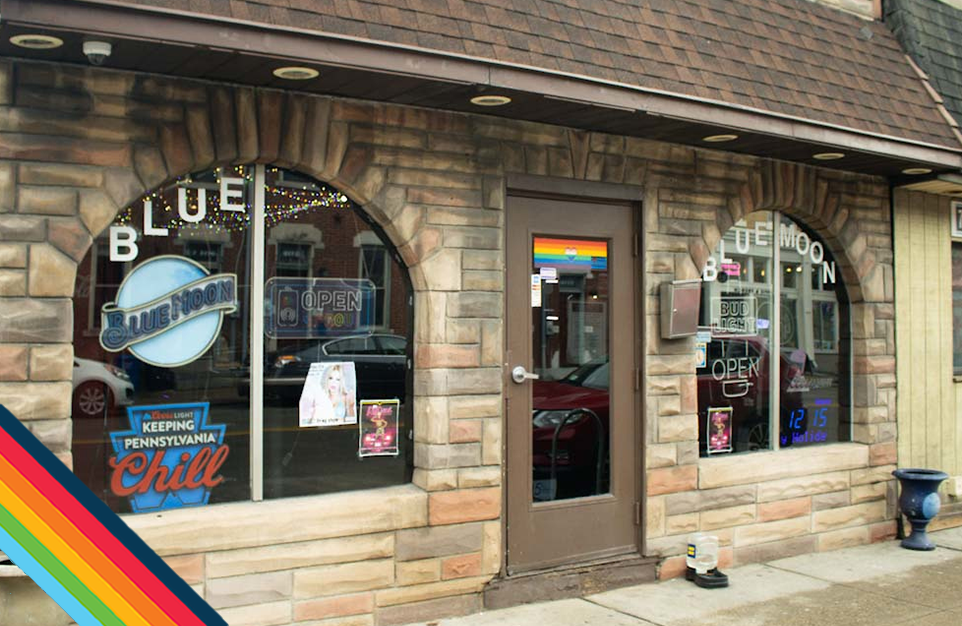
A few weeks ago, a popular Pittsburgh queer bar, The Blue Moon, hosted a regular event, an open-stage drag show. Controversy erupted after an artist in blackface performed their number – allegedly a tribute to a Tim Curry movie character – without interruption. They completed their number and left the stage.
Excepts from their performance were added to a promotional reel for that Open Stage event.
Word, images, and video clips spread on social media. The performer rationalized that it was a character and they hadn’t meant to be racist. They turned their social media accounts to private.
The world is on fire. Authoritarianism rests on racism. Addressing this situation in the context of Pittsburgh’s history with anti-Blackness and the larger socio-political climate is necessary for everyone.
You can read a solid summary at Qburgh.
Scholar Dr. Allison Wiltz wrote about the relationship of anti-Black racism and fascism in a 2025 essay
If we were to draw a Venn diagram illustrating the relationship between racism and fascism, there would be a significant overlap between the two. On one side, we have racism, the belief that one group is superior to others, which leads to discrimination and prejudice. On the other side, we have fascism, an ideology rooted in authoritarianism, where political opposition is suppressed to maintain a hierarchy based on racial, ethnic, or national identity. By othering marginalized groups, fascist regimes attempt to unify those who share a racial or national identity. But, they do so for nefarious purposes. The overlap between these concepts is vast, as fascist regimes traditionally use racism as a tool. For example, fascist regimes often spread nationalist, racist propaganda to marginalize certain groups. While racism can exist in any government, fascism rarely manifests without racism.
The world is on fire. That’s exactly why Pittsburgh’s LGBTQ (and larger) communities should respond to this particular incident in the context of our day to day experiences.
Accountability includes that young artist, but also the show hosts, the bar staff on site, and the management. Yes, it is a fair question to ask how on earth the artist could not know the costume was blackface. It is an even more critical question to ask why no one stopped the performance? The DJ, the hosts, the staff of the Blue Moon, every single white person in that bar – how on earth could you not recognize what was before you? Everyone in that space and tied to that event had the privilege to shut it down and they did not.
I do not know this performer and have no mutuals, no access. It is still my responsibility as a white person to hold them accountable. That’s what anti-racism requires. I can’t just condemn and turn away. You and I must add something to the dialogue, bring resources to the table.
So I watched the video, read the comments, and interviewed a few folx. That led to some interesting conversations about the current state of drag culture in Pittsburgh.
We cannot cede to ignorance, we cannot mistake innocence for ignorance. It is 2026. Having to revisit these similar scenarios every generation or so is clearly exhausting, pulling back the curtain on the incessant micro and macro racism our neighbors experience every single day.
“How could they not know?”
I can allow for the possibility that a person might not understand the racist impact of their performance. I cannot excuse them or their own support system for not teaching them. The lack of anti-racism tools and filters is a significant threat to our society. This is what happens when books are banned, DEI programs unfunded, algorithms lack diverse sources.this is the price we pay – we remain rooted in ignorance, isolated from the cultures and communities that make our world livable.
If mentors and mothers are teaching their proteges about makeup, outfits, and music – why not inject these issues of representation into that education? If show producers and hosts set rules around set lists, length, the music format, why can’t they set the expectation for a trauma informed show and performances?
Maybe they don’t know how to do that, but they learned all of these other things. This can be learned and instilled to younger generations.
This is what happens when people say “Why can’t Pittsburgh Black Pride merge into Pittsburgh Pride?” without considering that that means. When people think we only ‘need’ one Black trans led organization. When white Pittsburgh LGBTQ folx discuss safe neighborhoods and unaccompanied minors as hypotheticals instead of very real factors our Black Indigenous, Latinx, Asian and other LGBTQ+ neighbors of color navigate daily.
This is the inevitable consequence – on repeat – of our refusal as white Pittsburgh to acknowledge much less reconcile the realities of ‘two Pittsburghs.’
So maybe the performer didn’t know it was blackface. She should have known. She should have had the common sense as a white person putting black paint on her face that maybe she should do some research. This was not a small matter, it wasn’t a mistake or an error. It was denial, it was a choice not to question. She traumatized a room full of people as well as the larger Black community in the region.
The world is on fire and anti-Blackness is fuel poured on those flames when people make excuses for the impact of their choices. We all do it. But it is never okay.
Racist Drag Culture Did Not Start with Sharon Needles
In 2012, the emergence of a Pittsburgh based drag performer via the RuPaul Drag Race franchise dragged Pittsburgh’s terrible relationship with racism into the spotlight, Season Four artist Sharon Needles got her start at this same bar. Staff and other performers were shocked because they knew her history. She strutted in a swastika outfit. And she performed in Black face. She dressed in a one piece made from a Confederate flag. Receipts below.
And she didn’t care. She had a degree of confidence in her privilege that is familiar to me as a white Pittsburgh native. Why did it take her national prominence for the local queer and trans community to hold her accountable for these horrific choices in small spaces?
Yes, she experienced consequences, but what about everyone else? Who took it upon themselves to document the racism embedded in drag culture, both in Pittsburgh and around the world?
I often wondered what was happening at that bar that savvy barstaff could see the racism, but not feel empowered to do something about it.
Read these articles that describe her history and story. These links have violent anti-Black, racist, and antisemetic images and language.
We have failed Pittsburgh’s Black LGBTQ+ community and all of our BIPOC neighbors. We didn’t pivot from the exposure of Sharon Needles racism to examine our own. Yes, some anti-racism work has been done, inspired mostly by Black queer and trans women.
Sharon Needles didn’t invent drag racism. She just got caught. This link contains several graphic images using hate symbols Sharon Needles incorporated into her performances along with several quotes using racist language.
Shifting drag and bar culture
My hope is that this performer’s people are doing the work, not providing sanctuary. They need to be held accountable and accept the natural consequences. Clearly, they need an education on how not to be a racist. But we presume they are a first time public offender who can be educated.
But what about the other young performers? Artists? Mechanics? Food line workers? They deserve the same attention to their understanding of Black queer and trans experiences in Pittsburgh as drag performers. We are foolish to think Generation Z and Alpha Generation understand these dynamics just because they are young.
What does that look like in Pittsburgh’s LGBTQ+ community?
Chauntey MoNique is the founder of Love Diamond Project supporting Black trans women. After learning about this situation, she posted on social media – calling for artist to apologize and for a self-imposed ban from performing until they’ve made amends.
“The Blue Moon should respond and take responsibility,” says Chauntey. “They provided a platform for this. Drag is a platform that holds credibility so to not monitor it is irresponsible.”
She told me that a lot of people allowed this to happen, any one of whom could have stopped the performance or said something.
“Professionals should know that black face has a historical context and causes trauma,” she told me. “That room was full of adults who know, performers who know.”
As we spoke, I asked her what moving forward could look like. She would like the bar community and all show producers/DJ’s to participate in a locally led cultural competency training. She wants bar staff empowered to intervene without fear of losing their job.
“This is not just about offending the black LGBTQIA+ community, it’s about offending the principles of Pittsburgh’s drag scene and most importantly, Pittsburgh’s Black community in whole,” Chauntey posted on Facebook.
As of the time of our conversation, the Blue Moon had not responded to her concerns.
The Blue Moon management is struggling to respond. They’ve released a few statements. They waffle between denying the performance was black face and expressing horror at the thought of black face. They claim they are receiving death threats and are sharing personal health information about the performer. Clearly, they need some help righting this ship much less moving forward if they want to be a space where Black and other BIPOC members of the community feel affirmed, welcomed, and safe.
But that help should not be free work by Black trans women and drag artists. No free work by anyone. There are multiple resources in the community who can provide the necessary training or facilitate the necessary dialogue.
The reigning Miss Blue Moon, Andi Whorehol, identifies as an afab, black, lesbian drag queen. When we spoke nearly a week after the incident, she told me that no one from the bar had called her either to check on her or to ask for her inclusion in the response. That’s an opportunity lost.
“The bar has not checked in on me once to see how this is affecting their current black reigning Queen. It’s been hurtful to say the least,” says Andi.
As we spoke, I was mulling over how I could be part of forward momentum. Describing and documenting the trauma is important for historical purposes. But more is necessary. Andi and I brainstormed. More on that later.
In the Qburgh article, Black drag artist Leia Way LeStat pointed to the lack of support. Andi built on that to summarize how racism manifests in the drag scene:
- A lack of BIPOC representation in the decision-making roles behind the scenes
- All-white shows popping up more frequently as of late
- The tokenization of BIPOC entertainers within casts
- Poor turnouts for all- or majority-BIPOC shows (As Leia Way LeStat mentioned)
- Audience members being disrespectful and disruptive during BIPOC entertainers’ performers
What about me?
So I offered to bring my resources and privilege to that table, working with Andi on a blog feature. More details on that later.
I also waded into the fray of a conversation on Facebook where I ended up face to face with someone who claimed Stephen Foster wasn’t racist. Yes, yes he was. And his father founded Lawrenceville so racism is embedded in the streets, sidewalks, and structures of that neighborhood. Generations of Pittsburgh residents grew up steeped in that legacy.
And there’s one piece of the problem – there is a world of difference between someone who is ignorant in the sense of lacking information and someone who is willfully ignorant because they disregard or ignore information.
Saying Stephen Foster wasn’t racist is just hard to wrap my head around.
The conversation included denial, deflection, victim blaming, ‘whataboutisms’ and the ever popular ad hominem attacks.
I am preserving the video and images as well as screenshots of the apologies in this blog. I also grabbed documentation of Sharon Needles’ story. These are important parts of our history. We can’t let them be erased.
I am not posting the name of the performer because that’s missing the point.
I do hope every organization in this region that works with young people will incorporate education about anti-Blackness racism into their programming, especially young people ages 18-24+. We have to collectively reclaim DEI type awareness and tools as they are erased in mainstream spaces. That’s a shared responsibility.
It is also a responsibility that needs to be funded.
We can do better, but we have to first acknowledge how we’ve done harm, how we’ve traumatized our own communities. The rise of fascism in our nation is inextricably linked with racism that’s always been here.
We did start this fire.
Discover more from Pittsburgh Lesbian Correspondents
Subscribe to get the latest posts sent to your email.

You must be logged in to post a comment.