

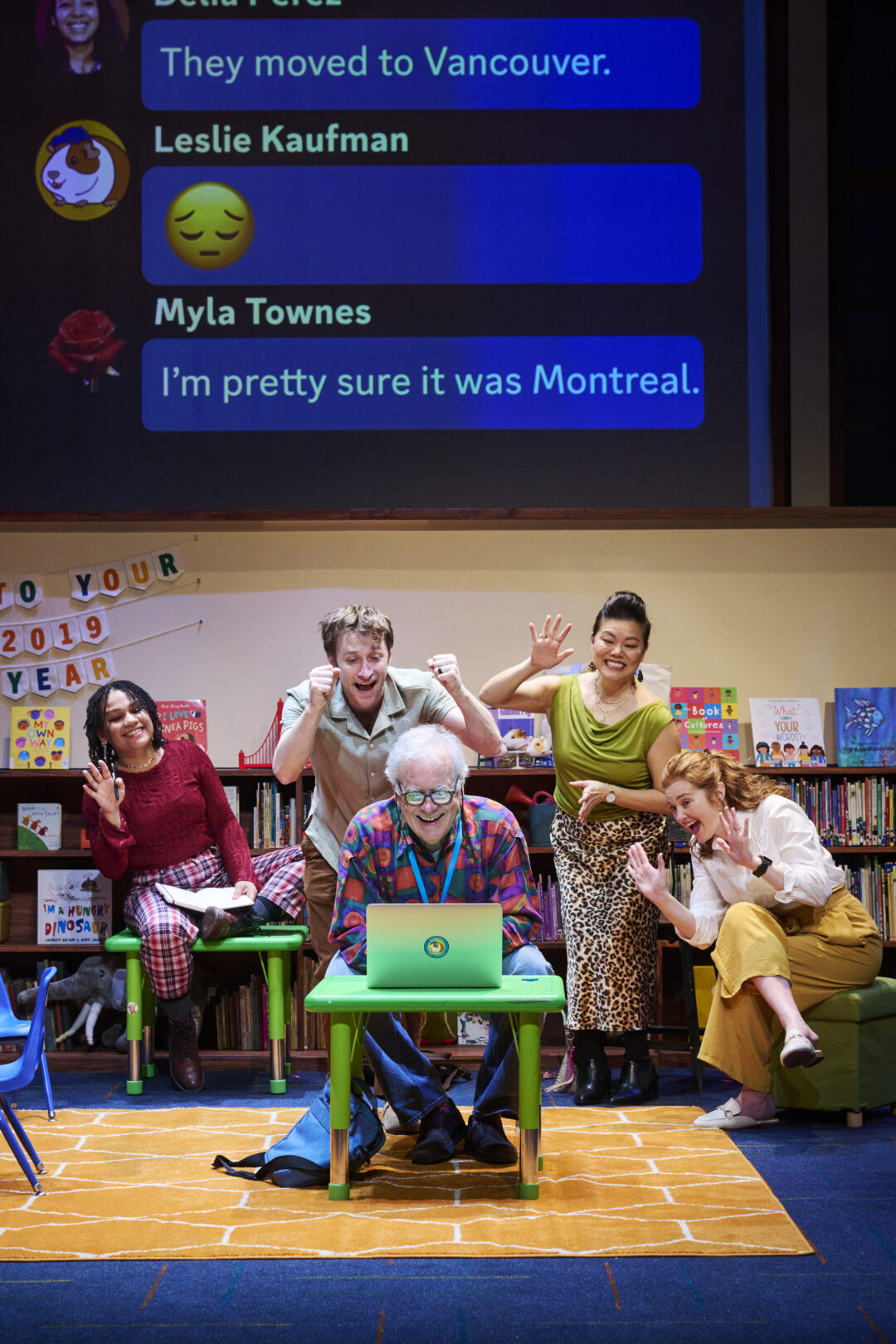
Eureka Day at City Theatre is a wry, sly, and thoughtful comedy that just might brighten your spring in a dark time.
Set in an elite private elementary school, the action centers a leadership committee (aka PTA) and a harried principal struggling to maintain a safe and supportive learning environment, controlling as much as possible to keep anything harm from infiltrating the school. The school is located in Berkeley, California.
It opens in the school library which is very intentional – bright colors, social justice books, learning activities, chairs for little, chairs for adults. The members of the committee gather to kick off the 2018/2019 school year.
Principal Don (John Shepard) has big feelings, seemingly genuine respect for multiculturalism, yet a telling tendency to read Rumi excerpts without any context beyond “wow, that’s great.” Chair Suzanne (Daina Michelle Griffith) a founding parent who may have been in this role for over a decade. She’s confident, determined to protect the school, and willing to work her fingers to the bone to do so. Meiko (Desiree Mee Jung) is a single mother having a clandestine affair with another member, Eli (Max Pavel), a stay at home father whose mansplaining ways meet his background in Big Tech. He’s filthy rich, but we don’t know this. Carina (Jalina McClarin) is the newest addition, in a same sex marriage raising at least one male child, a student who struggled in previous academic settings.
After an amusing albeit serious discussion about expanding the school application to include ‘transracial adoptee’ under the race/ethnicity dropdown box, Their earnest vagueness creates the impression that Suzanne is the queen been, Meiko her sidekick, Eli an overly eager to please tech bro, and Carina is ‘the new girl.’
The next twist puts all these assumptions to the test when an outbreak of the mumps hits the elementary school, quickly pitting the vaxxers v the anti-vaxxers against each other. The committee schedules a virtual community meeting that brings the hugest laughs of the show. The parents ‘chat’ inside the online meeting is projected behind the committee members, rendering their spoken dialogue unintelligible as the litany of insults, false logic, Nazi references unfold into a moray of bad behavior leaves Principal Don horrified.
This is where I had the biggest laugh I’ve had in months. It was well executed, prescient, and juicy with a wee bit of techno-oblivion that renders the inappropriate thumbs up hilarious.
More children get sick, a quarantine is imposed by the Health Department. Both Meiko and Eli’s children are ill, implying that they spent time together possibly transmitting the virus while their parents were hooking up. Meiko’s daughter recovers, Eli’s son is hospitalized and experiences serious consequences.
The crisis has Meiko and Eli, along with Don, reexamining their beliefs about vaccines, health, and tolerance. I think also they reconsidered how to really be a voice for the students.
Carina seems firmly mired in the science and research, firm in her insistence that they adopt stricter guidelines on vaccines. Don is willing as are Meiko and Eli, albeit more reluctantly. They all have come to close to the price their children will pay for doing otherwise.
But for Suzanne, this is not so clear. Suzanne has poured her entire life into building a safe school to protect what seems like a very large brood of kids. She’s donated all of her children books, woke at 4:30 AM each day in the years before the school had a cafeteria to prepare meals for all of the kids, and served in this leadership role, assiduously monitoring any threat to the children.
During a powerful monologue, Suzanne shares her motivation with Carina. Suzanne truly believes that vaccinations will kill other children. She believes she as a parent should get to make that decision for her family, but also that she has special insight into the ways in which Big Pharma and other special interests have twisted the narrative and deceived everyone about vaccine efficacy and safety.
The committee meets again. Don reminds everyone that in their school, no children are villains and that no parents are villains either. He believes in the power of consensus and shared values. He finally rises to the occasion when operating by consensus is not effective leadership. The bylaws of the school say they must operate by consensus and cannot change policy without it. But Don offers a backdoor maneuver – they can change the actual bylaws by majority vote. So they do.
The leadership configuration eventually changes and the school moves into the 2019-2020 school year confident they’ve navigated the worst of it. Wink, wink.
Suzanne’s superiority and condescension are quite unattractive qualities, but Griffith allows her vulnerability to peer out through her gestures and the softening of her expression when she realizes she’s hurt someone else. Suzanne got up at 4:30 AM five days a week for an unknown period of time to make sure the students had nutritious lunches. Cooking student lunches in a private kitchen isn’t a great public health choice. Perhaps the parents could have been trusted to prepare lunches for their own children? But it shows the true sacrifices she has made to keep the children safe. At least that’s how she sees it.
Suzanne’s roll moved from an understandable reaction to a terrible personal tragedy to an unwarranted belief that she had superior insight into health and safety. She let it take her too far, despite her protests that she is open-minded and concerned with everyone being welcome. The trauma of her own experience remains unprocessed.
Suzanne is not a villain. She is a woman still grieving a long ago tragedy, choosing tactics that reinforced her rigid certainty and never allowed her to rebuild a sense of truth with physicians. She is wounded and needs to be embraced still as part of the community, but she cannot guide if she will not accept the consequences of her choices.
Meiko’s guilt that her child may have transmitted the virus to Eli’s son haunts her. She finds her voice and makes choices that better reflect her values.
Eli’s goodhearted self-centered mansplaining self fades as his son recovers. He steps in to help the school recover financially.
Perhaps we could find moments where Suzanne and Carina’s connection over truly wanting to protect their children forges an understanding, even while the better public health policy must prevail.
I saw this play the day after a federal district court put a full stop to Robert F. Kennedy Jr.’s vaccine revisions. The character Carina makes a reference to the very real Vaccine Court. One point is that while many parents say their child was “fine” before a vaccination, the actual clinical notes do not support that perspective. Doctors note that children are showing symptoms or failing to developmental targets, perhaps not enough for a full diagnosis, but enough to show that their was reason for concern. Do doctors fail to share this information? Do families not want to hear that their child is less than perfect? A combination of both?
The program has an informative history of vaccine denial.
The set was simple, but colorful – the school library and a few scenes in a hospital corridor, nicely managed by rolling backgrounds and lighting. There’s the impression that the curated books will shape the children without a computer station in sight.
What else I didn’t see was an elevator. The library had two sets of steps, but no indication of elevator or similar resource to make the library accessible. Was that a deliberate design choice, as these able-bodied adults trip down stairs to make health decisions without accommodating students whose health may be more compromised by a viral breakout.
Of course, City Theatre created a mocktail and cocktail to go along with the show. I opted for the cocktail as I wasn’t driving. It was delicious and I grabbed photos of the recipes.
The show opened with a video from the theater co-directors, sharing the success of seasons past and asking for help to move forward in a political climate hostile to the arts. City Theatre has opted to continue forward. I hope we see more proactive social media content, accessible theatre, and my perpetual plea to send the recipes and the playlist exclusively to guests who attend a performance.
Griffith is a familiar face, especially from her role a few years age in The Revolutionists. Pavel did double duty last year in Witch as the Devil and as Director. Shepard was a chilling villain character in Downstairs, the complete opposite of Dave. Mee Jung is new to the Pittsburgh theater. McClarin’s profile was refreshingly vague, perhaps alt-profile? She embraced theatre as inherently political with one simple sentence. #TeaSnap
The set as I sad was great except for the absence of an elevator. The costuming was also great – lots of days passing meant lots of costume changes. Suzanne was dressed as a crunchy affluent matriarch while Carina wore some fantastic colorful outfits. Meiko was dressed very sharply, with killer boots. And Eli was just wearing khakis and being his best self.
More snap for set designer Sascha Jin Schwartz and Costume Designer Jaime Ericson.
This is an important play. I can’t find common ground with someone who wants to eradicate me or other neighbors. I can perhaps establish shared values with someone whose trauma is preyed upon by the former. Still, we all have a moral and ethical duty to good public health policy grounded in science and free of any undue interests.
Including our own.
Eureka Day runs through Sunday, March 29 at City Theatre.
Discover more from Pittsburgh Lesbian Correspondents
Subscribe to get the latest posts sent to your email.



You must be logged in to post a comment.