
The two bills were motivated by similar realities at the federal level, where federal executive orders have weakened fair housing and other protections for various protected classes.
City Councilor Erika Strassburger steered two pieces of legislation that addressed and bolstered nondiscrimination protections in the City. Protections based on sexual orientation were first added to the code in 1991 after a massive effort by local activists, who spent hours reviewing signatures on the ballot measure. In the late 90’s, City Councilors expanded the definition of sex discrimination to include gender identity. Several years later, the language was updated to be more explicit and direct.
Councilor Strassburger identified existing weaknesses regarding the protections for survivors of domestic violence as well as recognizing how federal actions may weaken existing protections. It is a really good example of the power and authority of local government to protect us from abusive elected officials. That attention to language and detail could be critical for any of us.
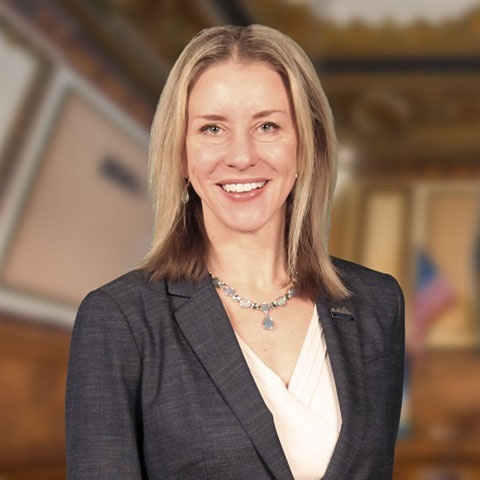
Name: Erika Strassburger
Pronouns: she/her/hers
Title: Pittsburgh City Councilmember
How do you describe your identity?
I cherish my identity as a parent, partner, daughter, daughter-in-law, and friend. I identify as female, straight, cisgender, and white. My identity is also currently tied to my vocation as a City Council member, and I prefer to be identified as a public servant rather than a politician.
You plan to introduce two pieces of legislation around the definitions of protected classes that already exist under the federal government, and make sure the same phrasing is enshrined at the local level. Please tell us about each piece of legislation.
The legislation I introduced, that was written with the help of Pittsburgh’s Commission on Human Relations (PghCHR), seeks to simplify the language of our nondiscrimination code, define terms that have not been previously defined in our code (like “protected class” and “protected activity”), preserve the antidiscrimination enforcement power of the City in the wake of federal changes, expand the umbrella of protections more explicitly so Pittsburghers know how they are protected from discrimination, and remove barriers currently in place to allow for investigations to happen simultaneously when filed with both PghCHR and the Office of Municipal Investigations.
The protected classes in your legislation include sexual orientation, gender identity and expression, immigration status, and survivors of domestic violence. Please give examples of how people in these classes might experience discrimination at the City level?
This bill continues the explicit protections of protected classes already defined in city code, including sexual orientation, gender identity and expression, immigration status, and survivors of domestic violence. As an example, one might experience workplace discrimination, such as different treatment in the workplace or unfair hiring practices due to one’s sexual orientation or gender identity or expression; or housing discrimination, such as eviction, because of one’s status as a victim or survivor of domestic violence. There are three broad categories that the City’s non-discrimination code governs: housing, employment, and public accommodations, and any number of ways individuals might experience discrimination in any of these categories.
City Council recently clarified language in the City nondiscrimination code. How does that relate to your legislation?
The two bills were motivated by similar realities at the federal level, where federal executive orders have weakened fair housing and other protections for various protected classes. Bill 2025-2242, which is now law, defines “Housing Status” to include homelessness and adds it as a protected class. The bill I sponsored continued the effort to prevent housing discrimination by creating a definition for “Protected Class”, “Perceived Protected Class”, “Protected Activity”, and “Disparate Impact”; the last definition is increasingly important in light of federal fair housing rollbacks.
Why were these definitions not included in the original legislation or previous updates?
The vast majority of definitions stated or restated in the bill I introduced were already in city code. My bill added four new definitions: Protected Class, Perceived Protected Class, Protected Activity, and Disparate Impact. It also further defined and updated existing definitions and protected classes.
As we watch our federal government descend into authoritarianism, state and local government – including school boards – are a significant line of defense. What types of concerns are your constituents bringing to you?
I have heard from constituents and other city residents who identify as queer or LGBTQ+ who fear additional rollbacks will threaten their civil rights. Particularly trans individuals and parents of trans youth are fearful for their own or their children’s safety and mental health as trans folks continue to be scapegoated and othered throughout this administration. I’m also hearing from my immigrant neighbors and constituents, who fear that the indiscriminate ICE arrests will come for them or their family members. Many don’t leave home without their passports, green cards, or other documents.
What other steps has the City Council taken to ‘future proof’ against federal actions?
We are proud that Pittsburgh remains a haven for its residents and workers, particularly in the face of federal actions and the failure to protect Pennsylvanians from discrimination. Additionally, we have underscored our policy forbidding our police officers from coordinating with or assisting ICE. We have used our legal power to sign on to numerous lawsuits challenging federal administrative rollbacks, and we have challenged contract language that claims federal grants will not be honored if Pittsburgh does not sign on to specific provisions (such as anti-DEI clauses).
What would the impact be of the Mayor’s proposed budget for 2026 on the capacity of OCHR to implement these changes? As I understand it, OCHR will be moved from under the Mayor’s direct authority to another unspecified department, and any current staff vacancies would remain unfilled.
The proposed budget allows the Commission on Human Relations to remain an independent commission outside the Mayor’s direct management. The CHR director and staff will remain under the CHR board’s direction. There are no significant changes to CHR, other than a modest budget increase to cover cost-of-living increases.
In 2023, you sponsored legislation protecting survivors of domestic violence. Is there a connection between the two sets of legislation?
Yes, absolutely. I was proud to pass legislation protecting survivors of domestic violence in 2023, but with the new administration, we had to go further. My recent legislation, in collaboration with Pittsburgh’s Commission on Human Relations, strengthens the protections passed in 2023. We wanted to ensure that, as a City, we could protect our residents even when the federal government fails to do so.
Affordable housing is a consistent theme for people who experience discrimination based on their identity, survivors of domestic violence, and poor folx in general. Most of the barriers to rental or home ownership are fundamentally economic, forcing vulnerable populations out of the City to communities without these protections. How does the City use the tools you propose to create more affordable housing and avoid this trend?
There are multiple answers to this question. When it comes to survivors of domestic violence, we know that the economic barriers can be the reason a person stays with their abuser. That’s why laws that help survivors keep their jobs and prevent eviction are so important. For others who experience discrimination based on their identity, there can often be other overlapping challenges present – they could be lower income, live with a disability, face racial discrimination, or have any number of barriers to finding housing that is affordable to them. Protecting folks from discrimination in housing and employment is only the start. While creating and preserving affordable housing at all price points is complicated, with no one easy answer, it’s something I am committed to, particularly in the well-resourced, walkable, transit-rich district I represent.
Also, previously, voters approved a referendum to modify the City Charter regarding discrimination. It feels like there are a lot of loose ends to tighten up. Are there other areas to be addressed?
The next issue will likely be additional housing protections, and I will rely heavily on fair housing experts to understand what more the city can do in this regard.
Why are you so passionate about supporting survivors of domestic violence?
No one should be punished simply because they have found themself in an abusive relationship. Knowing how difficult it is for people to leave these relationships when the abuser has often gained emotional, financial, social, and physical power over them, I felt strongly that they should have every tool possible to gain their independence, freedom, and safety. First and foremost, they need a safe and secure place to live. That’s why I further strengthened the rights of a victim of domestic violence to avoid eviction, require property owners to change the locks of their dwelling unit, and prevent discrimination based on their history. The same goes for employment – it is now illegal for an employer to discriminate against an employee on this basis. If an employee must attend a court hearing related to their case, for instance, the employer may not penalize them at work for doing so.
What percentage of your district is made up of immigrants, refugees, and their children?
This is a data point I was not able to locate. Although if there is a count, it is likely underreported. In District 8 we have a large international student population and common languages spoken in the district are Arabic, Mandarin, Russian, and Spanish.
What can we expect in early 2026 with a new Mayor?
I predict that the new Mayor will set an agenda that prioritizes fiscal responsibility and excellent city services, and then will grow and evolve from there.
Thank you, Erika.
Don’t miss other blog posts like this one – subscribe today so each post lands in your inbox.